
Seeing Akihabara's Signs and Streetscapes as a Group: 4 Common Mistakes and How to Avoid Them
Seeing Akihabara's Signs and Streetscapes as a Group: 4 Common Mistakes and How to Avoid Them
Look up, and the building walls are covered in lettering: red, yellow, light blue. Katakana, kanji, and the Roman alphabet run both vertically and horizontally, and LED screens flicker in the gaps between them. In Akihabara's Electric Town in Tokyo, you notice the signs before you notice the sky.
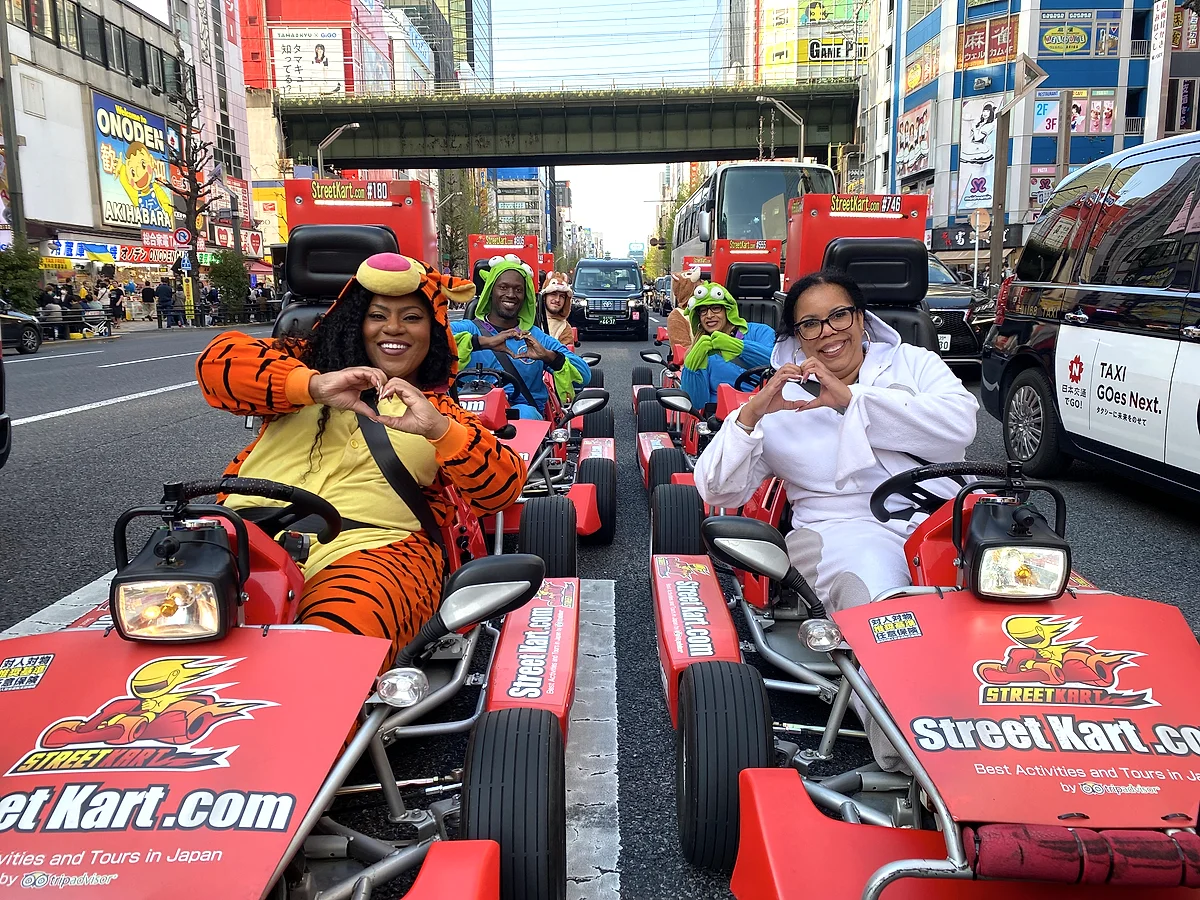
The view is even more fun when you share it with friends. But the bigger the group, the more things can go wrong. People get split up on the way to the meeting spot, the reservation you wanted is full, or everyone gets so busy taking photos that they miss the scenery itself. All of these happen a lot.
This article is for groups who want to enjoy Akihabara's signs and streetscapes. It covers four common mistakes one at a time, along with how to avoid each one. It also explains how to plan around a Street Kart tour if you add one to your schedule.
Akihabara's Signs Stack "Up" and "Back"
First, it helps to understand how the signs in this neighborhood layer on top of each other. Once you see that, it's easier to figure out where to stand and what to look at.
In Akihabara's Electric Town, signs are stacked several tiers high on building fronts. There's the shop name on the first floor, another on the second, and more above that. Projecting signs jut out over the street, and signs on buildings farther away peek through the gaps between the ones in front. Move half a step, and a different set of words comes into view.
Seen with a designer's eye, the whole thing is a giant collage. The colors clash and the letters come in every size, yet somehow it all moves to a single rhythm. Every wall seems to be calling out to you. That noise is what gives the neighborhood its character.
When you leave through the Electric Town Exit, you'll see the big Yodobashi Camera building and Akihabara UDX. This is where the view begins. Stop, tilt your head back, and a silent chorus starts up.
The same street looks different depending on the time of day. In daylight you notice the colors and shapes of the lettering, and it's fun to work out which shop sells what. As the sun goes down, the illuminated signs and screens take over, and whole walls start to look like one big light fixture. If you're going as a group, decide early whether you want to see the "daytime signs" or the "evening signs." That makes it easier to choose whether to walk around before or after the tour.
Mistake 1: Trying to Photograph Signs While Driving
Let's start with the mistake you should avoid most.
On Street Kart tours from the Akihabara 1st and 2nd shops, the signs of Akihabara's Electric Town are one of the highlights along the route. You're driving a kart through a neighborhood full of signs, so of course you'll want photos. Even so, don't hold your phone while you're driving.
A guide leads each tour and controls the route. While driving, keep your eyes on the kart in front of you, the guide's signals, and the traffic around you. Save the sign-gazing for your walk before or after the tour.
Another idea people tend to have is to stop in front of an interesting shop and hop out for a quick look. How the tour runs is up to the guide on the day, so don't plan on making detours of your own. Decide from the start that you'll take your time photographing signs on foot before or after the tour. It takes the pressure off.
Your group might be tempted to pick a "designated photographer," but everyone is a driver while the karts are moving. The karts are single-seaters, so nobody can hand off the driving and take photos instead. That's why planning your photos for before and after the drive is really planning how the whole group will enjoy the day.
Tips for Taking Photos on Foot
Here are a few tips for taking photos on foot before or after the tour. When you photograph a sign-filled street with a phone, the bright signs tend to throw off the exposure, so the image gets washed out or people's faces come out dark. Tap the brightest sign on the screen to set the exposure there, then pull it down a little. The colors of the signs come out much richer. I use this trick every time I shoot a city at night.
If you're taking a group photo, avoid the middle of the sidewalk and move close to a building wall. Line up for a few seconds, take the shot, and move on. Foot traffic on Akihabara's sidewalks rarely lets up, so that alone makes a big difference for the people around you. Don't photograph shop staff or the inside of shops without asking, either. If you're unsure, smile and ask. That usually settles it.
Good places to shoot include the area around the Electric Town Exit, around Radio Kaikan, and the station front where Yodobashi Camera Akihabara stands. All are within walking distance of the Akihabara shops (local guides list both Radio Kaikan and Yodobashi Camera as about a 3-minute walk).
To capture the vertically stacked signs, hold your phone in portrait orientation and shoot upward from a slight crouch. You'll fit the lettering from the ground floor to the top floor into one frame and capture the "stacking" that makes this neighborhood what it is. If you're including people, focus at face level on someone standing with the signs behind them. Don't worry if the lettering in the background blurs a little. The shot will still come together.
Mistake 2: "Meet at Akihabara Station" Scatters the Group
On trips with a lot of people, meeting up often takes longer than expected.
Akihabara Station is served by JR, the Tokyo Metro Hibiya Line, and the Tsukuba Express, and it has many exits. If all you say is "let's meet at Akihabara Station," one person ends up at the Electric Town Exit, another at a different exit, and a third gets lost underground. In a group from several countries, someone may also misread an exit name.
The fix is simple. Set your meeting point by the name of an exit, not the station. For example, name a spot like "just outside the Electric Town Exit," so everyone is looking for the same words. Sharing a map pin also makes it harder for members who can't read Japanese to get lost.
It's also important to confirm which shop you booked. Akihabara has a 1st shop and a 2nd shop. Post the one you reserved in your group chat so everyone knows. If people only remember "the Street Kart in Akihabara," you may end up staring at a map on the day, asking, "Wait, which one?"
Then there's transportation. The shops have no parking, so taking the train or other public transit is recommended. If you're scheduling something before the tour, work backward from the meeting time and don't plan to arrive at the last minute. With a big group, one person running late means everyone waits.
When you share the meeting details, include notes on clothing and bags too, so nobody scrambles on the day. Wear closed-toe shoes such as sneakers. Sandals, heels, skirts, and dresses are listed as things to avoid. Keep your bag small. The shop lockers are meant for small items and aren't suited to large luggage like suitcases. If anyone is joining partway through a day of sightseeing, ask them to drop their big bags at the hotel first. That way, nobody is left at the front desk wondering where to put their luggage.
Mistake 3: Setting the Date Before Everyone Meets the Requirements
It's easy to get excited, say "let's go on this day," and lock in the date first. With Street Kart, though, there are things to sort out before the date.
The first is driver's licenses. The karts are single-seaters, and passengers aren't allowed. Everyone who rides must meet the driving requirements on their own. License rules vary by country, so send the driver's license page on the official website to everyone in the group and have each person check for themselves. See the official website for full details. If you find out at this stage that even one person doesn't qualify, you can rework the plan before setting a date.
The second is when to book. Weekends tend to fill up, so book early. The more people you have, the more it depends on that day's availability whether everyone can join the same session. Instead of settling on one date, offer two or three options to make scheduling easier. For details on how groups can join, check the official website.
Reservations are accepted via Facebook, LINE, and email. You can find the contact options and the latest information on the official website. Choose one person to handle bookings and have them collect everyone's preferred dates and license status before reaching out. That way you can sort it all out in one exchange.
Talk about the weather while you're picking dates, too. In light to moderate rain, tours run as scheduled and raincoats are provided. In heavy rain or typhoons, tours are canceled. Check the official website for how cancellations are handled, and settle on a backup plan as a group, such as "if it's canceled, we'll move to this day." After the rain, the colors of Akihabara's signs reflect off the wet pavement, giving you a different view from a sunny day.
Another request that often comes up in groups is, "We want to drive past the signs in matching costumes." The costumes are Street Kart originals provided by the company and are first come, first served. Wearing one is optional, and you can join in your own clothes. Don't plan on bringing costumes of your own. Expect to choose from whatever is available on the day.
Ease Language Worries Before You Head Out
On tour day, guidance is mainly in English. If some members aren't comfortable with English, give them the key points in their own language before you set out, such as "watch the guide's signals closely" and "follow the kart in front of you."
Guidance in Japanese or other languages depends on the staff that day and isn't guaranteed. If it's a real concern, contact them through the official website ahead of time. If anything in the safety briefing or the guide's instructions is unclear, don't let it slide. Ask the staff before you set off. Whatever their nationality, everyone in the line of karts is one team.
Mistake 4: Cramming Too Many Shops Around the Tour
Akihabara's signs aren't just decoration. Every one of them is beckoning you inside: Animate Akihabara, Sofmap, Radio Kaikan, Mandarake. You walk into one shop while gazing at the signs, and before you know it, it's time to meet. The bigger the group, the more often this happens.
To avoid it, agree as a group from the start that shopping comes after the tour. It's much easier to meet up with light bags and browse the shops at your leisure after the drive than to show up hauling big shopping bags.
If you want to fit something in before the tour, choose something whose timing is easy to predict. Kanda Myojin is one example. It's a shrine about a 10-minute walk from the Akihabara shops, known as the guardian shrine of old Edo. Walk a short way from the busy Electric Town, and the sounds around you suddenly change.
After the tour, splitting up by interest isn't a bad idea either. Some want anime goods, some want electronics, some just want to rest at a café. Set a meeting place and time, and let everyone go after what they love. It's like dancing to the same song with everyone doing their own steps. You're all doing different things, yet somehow still connected.
If you chose a course that passes Tokyo Station or Ginza, try walking that route again after the drive. Tokyo Station is about 5 minutes from Akihabara by train. From the kart, the red-brick station building flashes by in an instant. On foot, standing in front of it, you can take in the rows of windows and the shape of the roof. Walking along saying "we drove right around here earlier" lets you enjoy the same scenery twice.
Why Street Kart Works for Exploring the Neighborhood of Signs: 3 Things That Matter
After all this talk of mistakes, here's a summary of what Street Kart offers.
First, depending on the course, a single tour can show you many sides of Tokyo. Routes from the Akihabara shops include the Electric Town's signs as well as landmarks such as the red-brick Marunouchi building of Tokyo Station and Ginza. On courses that run from Akihabara to Tokyo Station and Ginza, the main attraction changes once you leave the Electric Town, with its overlapping colors and lettering. There's the red-brick station building, which opened in 1914 and finished restoration in 2012, and the Wako clock tower at the Ginza 4-chome intersection. After the flood of color, a calm streetscape of stone and brick appears. It's like the moment a song suddenly changes key. For which places are included on which course, see the official website (kart.st).
Second, its track record. As of November 2023, its shops had run more than 150,000 tours in total, served more than 1.34 million customers, and collected more than 20,000 reviews with an average rating of 4.9 out of 5.0. All of these figures are as of November 2023.
Third, you can choose a shop to suit your travel plans. There are 9 shops in Japan (7 in Tokyo, 1 in Osaka, 1 in Okinawa). Of the 7 Tokyo shops, the Akihabara 1st and 2nd shops sit close together, as do the Shibuya shop and Shibuya Annex, so the 7 shops don't mean 7 separate areas. Still, you can choose between Akihabara and other areas such as Shibuya or Shinagawa based on where you're staying and what else you're doing that day. If the neighborhood of signs is what you're after, the Akihabara shops are the obvious choice.
Once you have a shop and course in mind, all that's left is the date.
Next Step: Start by Suggesting 3 Possible Dates
If you've read this far, there are three things to do. Post three possible dates in your group chat. Send everyone the link to the driver's license page. Pick one person to handle bookings. Once those three are done, the rest of the planning gets much easier.
Prices vary by season and time of day, so check the official website (kart.st) for the latest rates. Weekends tend to fill up, so get in touch early once your dates take shape.
The more eyes you bring to Akihabara's signs, the more you'll find. Someone points and asks, "What's that red sign for?" Someone else answers, and another person points to the next one. Once that back-and-forth starts, Akihabara is your neighborhood for the day.
This article was originally written in Japanese and translated using AI. Some expressions may read unnaturally, and we appreciate your understanding. For the most accurate and up-to-date information, please refer to the official site at kart.st.
Street Kart is not affiliated with Nintendo or the Mario Kart series in any way. We do not provide costumes of Nintendo characters, and such costumes may not be worn during tours even if brought by participants.