
Street Karting in Tokyo With Coworkers, Round Two: Pick a Different Store and Lock In Big-Group Plans Early
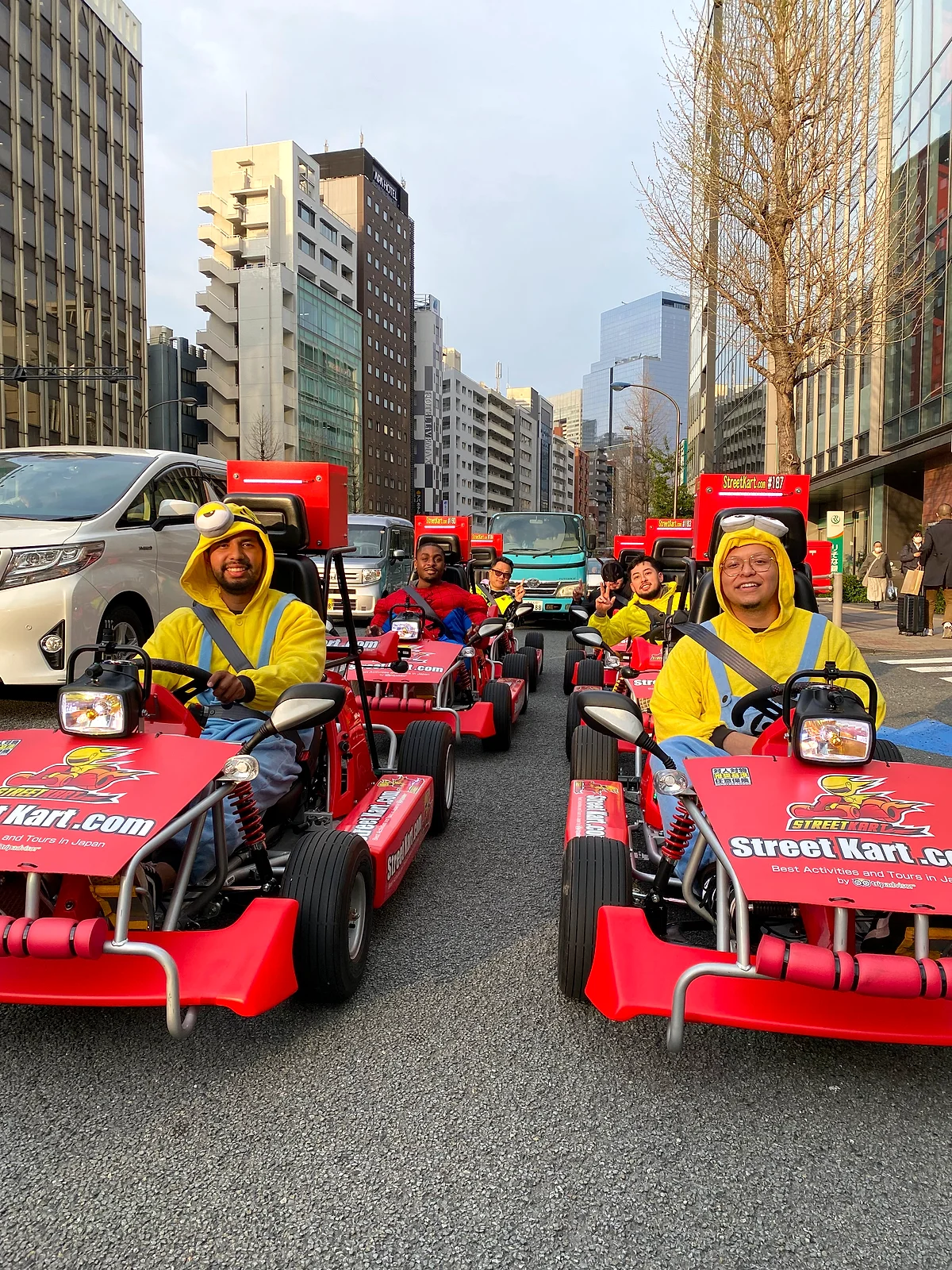
Street Karting in Tokyo With Coworkers, Round Two: Pick a Different Store and Lock In Big-Group Plans Early
"That kart ride last time was a blast, wasn't it?"
Someone says it near the end of a night out, setting their glass down. Usually, that's when the plan starts to move.
A team that rode street karts together in Tokyo once is now thinking about getting back together. That's a good sign. On the second ride, the slightly giddy nerves of first settling into the seat won't come back. Other things to enjoy take their place: which store to start from, who takes charge of the planning, where to raise a glass after the ride. Last time you went with the flow. This time you can make the choices yourselves.
This article is for coworker groups who have ridden once and want to get a little more out of the second time. It covers how to choose a different store and how to plan when the group is large.
You've Ridden Once, So This Time Rethink Where You Start
First, remember that Street Kart is a guided tour where you follow a guide. You don't just cruise down any road you like. Each store has its own courses, so if you want different scenery the second time, the first thing to decide is which store to start from.
Street Kart has nine stores nationwide, and seven of them are in Tokyo. Note, though, that Akihabara Store 1 and Store 2 are almost in the same spot, as are the Shibuya store and Shibuya ANNEX. That doesn't mean you can start from seven separate neighborhoods, so don't mix this up. Still, Tokyo has stores near the bay and stores in the city center, and what you see from each is quite different. Pick a different store from last time, and the same group of people should see a very different Tokyo.
Open Bay Views or City Streets?
Here are the landmarks that official materials list as highlights of the routes, store by store.
From the Tokyo Bay store (Shinkiba), the star is the Rainbow Bridge over Tokyo Bay. It's a 798 m suspension bridge lit up in seven colors at night. In the distance stands the 333 m Tokyo Tower. The Shinkiba warehouse district and the Odaiba area, home to the Fuji TV headquarters building, are also listed as highlights. The view is wide, and your eyes keep drifting toward the horizon.
The Shinagawa store's routes also look out on bayside landmarks: the high-rises around Shinagawa Station, the Rainbow Bridge seen from the Shinagawa side, and Tokyo Tower in the distance. The materials also list the Takanawa area, home to Sengakuji Temple, and the Shibaura and Tamachi areas, where office buildings sit next to waterfront views. The business district and the sea stand back to back, a pairing that suits Tokyo's southern gateway.
The Akihabara stores' routes give you old and new one after another. There's the red brick of Tokyo Station's Marunouchi Building, which opened in 1914 and finished restoration in 2012. There's the Wako clock tower at the Ginza 4-chome intersection. And there's Electric Town, lined with Yodobashi Camera, Akihabara UDX and more. Kanda Myojin Shrine and Ochanomizu, home to Nikolai-do Cathedral, are nearby too.
The Shibuya store and Shibuya ANNEX have routes with strong street culture: the Shibuya Scramble Crossing, the Hachiko statue and SHIBUYA109. Harajuku's Takeshita Street and the zelkova-lined Omotesando are on the list too, along with the greenery of Meiji Jingu Shrine and Yoyogi Park nearby.
If you rode the bay area last time, try the streets of Akihabara or Shibuya this time. If you started in Shibuya last time, head toward the Rainbow Bridge. Changing just one thing, the store, should make the second ride feel like a completely different day.
You look up at the city from a different height than when you're walking, and you move forward feeling the wind and street sounds. The low growl of the engine hums through your hips, and the moment the light turns green, it feels like the whole city starts moving to one rhythm. For me, this is why it never gets old, no matter how many times I ride.
Some people were too busy getting used to the controls the first time. The second time, you can relax a little. While following the guide, you might notice the fine details of the red brick or the color of a building across the intersection. Course details can change, so check the Street Kart official website for specifics.
Planning for a Large Group: Start by Offering Several Dates
The hardest part of a coworker outing isn't driving the kart. It's getting everyone onto the same date.
My Brazilian friends would probably just say, "Whoever can make it on the day, let's meet up." That has its own charm. But the common Japanese workplace approach of offering three candidate dates and voting works well for booking a large group. Both styles have their strengths, and for booking karts I think the Japanese way is the better fit.
The first thing to decide is a single organizer to handle the planning. Last time's organizer can do it again, or someone with experience can back up a new organizer. With one point of contact, there's far less back-and-forth.
Next, offer several candidate dates. Weekends tend to book up, so it's best to move early. Looking only at weekends narrows your options, so include weekdays off and evenings after work to give the team more flexibility. A poll in your group chat shows at a glance who can make it when.
Booking inquiries are accepted via Facebook, LINE and email. When you get in touch, give the number of people and your candidate dates together. One thing to know: a standard group is up to six drivers plus one guide. According to the materials, larger groups are handled only at the Tokyo Bay store, where they ride split into multiple groups. Depending on your numbers, this can affect which store you choose, so rather than assuming a certain size will be fine, check each candidate date and store with them. Ride in two groups and meet up afterward: plan around that from the start and things get easier.
Another important point is a deadline for confirming headcount. The source materials say cancellations up to seven days in advance are free. Set your team's internal deadline a little before that, so a sudden business trip or illness won't throw you into a panic. Cancellation policies can change, so check the latest terms when you book.
I recommend meeting at the station on the day. The stores have no parking, so take public transportation. According to official materials, the Shinagawa store is a 3-minute walk from Kita-Shinagawa Station, the Shibuya store and Shibuya ANNEX are a 5-minute walk from Shinsen Station, and the Tokyo Bay store is an 8-minute walk from Shinkiba Station. When a big group travels separately, someone usually gets lost. It's more reliable to gather at the ticket gates of the nearest station and walk over together.
Check Licenses Before You Book
A second outing may include new faces: people who transferred in, new hires, or people who couldn't make it last time. Before booking, ask them to confirm that they can drive with their license.
Everyone who rode last time should check too, just in case. Make sure nothing about your license has changed, and review what to bring. The required license types and items are listed on the official website's driver's license page. Please check there for details. Being told at reception, "You can't ride with this license," is the worst outcome for the person and for the friends waiting. The organizer can post the link in the chat and say, "Everyone, please check, and react with a sticker if you're OK." That alone removes most of the worry.
Tour Guidance Is in English, So Make Sure the Team Knows
On the day of the tour, guidance is basically in English. Whether guidance in Japanese or other languages is available depends on the staff that day and isn't guaranteed.
For a multinational team, English may be a handy common language. For a mostly Japanese team, hearing instructions in English can feel a bit like being on a trip, which isn't bad either. Either way, if you tell the team in advance that guidance is mainly in English, fewer people will be caught off guard on the day. If you have any concerns about language, raise them when you make your booking inquiry.
This is where a returning team has an advantage. Members who rode last time remember the guide's signals and the feel of the briefing before departure. Just telling newcomers, "There's a briefing kind of like this," can take some weight off their shoulders. Of course, the staff's explanation on the day comes first. Treat the veterans' stories as mental preparation only.
Besides, words aren't everything. A guide's hand signal, a nod, a quick smile. In my experience, people understand each other without words more often than you'd expect. You smile and say "OK." Sometimes that's all it takes for the tension to melt away.
The website supports 22 languages. For a team of mixed nationalities, it's a good idea to say, "Check whether the site has a language that's easy for you to read."
Street Kart's Appeal, Seen With Second-Time Eyes
Some things only come into view after you've done it once. Here's what a returning team can appreciate again, one by one.
First, a trained guide leads at the front. The organizer doesn't have to plan a route, and no one has to navigate with a map in hand. With a large group, it helps to take one task off the organizer's plate.
Second, the track record. As of November 2023, the company reports more than 150,000 tours run, more than 1.34 million customers, more than 20,000 reviews, an average rating of 4.9/5.0 and more than 250 vehicles. If you mention these figures at work, be sure to note that they're "as of November 2023."
Decide Where to Meet After the Ride, Too
What really makes a second outing stand out is what happens after the tour. Right after the ride, while everyone is still a little buzzed from it, where does the group head? Decide this in advance and the group won't linger aimlessly before splitting up, and the day wraps up neatly.
If you ride from the Shibuya store or Shibuya ANNEX, official materials list Dogenzaka Ramen Yokocho as an 8-minute walk and Shibuya Niku Yokocho as a 10-minute walk. They're close enough to carry the post-ride glow straight into a toast. If anyone wants to walk to Omotesando, it's about 15 minutes. Strolling under the zelkova trees at a different speed than a few minutes ago is a nice touch.
From the Shinagawa store, Shinagawa Shrine is a 5-minute walk. You could climb its stone steps before the ride and start from there. After the ride, Tennozu Isle, with galleries and cafés along the canal, is a 20-minute walk. The area around Shinagawa Station has plenty of Japanese, Western and Chinese restaurants.
From the Akihabara stores, Kanda Myojin Shrine is a 10-minute walk, and the long-established soba restaurant Kanda Yabusoba is a 15-minute walk, according to the materials. Talking as a team about where to go next while watching the glow of Electric Town's signs is nice in its own way.
From the Tokyo Bay store, there's the café-restaurant CASICA at Shinkiba, the nearest station. From there, you could also head over to Odaiba or Toyosu for dinner.
With a large group, the rule of thumb is to reserve a restaurant separately from the tour. With a big party, there are only so many places you can walk into on the day. Tour length varies by plan and conditions on the day, so don't set your restaurant reservation to the exact end of the tour. Leave a little buffer.
A quick note on photos. Don't touch your phone while riding, and follow the guide's instructions. Take photos in front of the store before the tour, or all together after the ride. At night, include neon signs and streetlights in the background, and just bracing your phone lightly against a railing or wall will reduce blur. For the full-group shot, faces right after the ride look best.
Round Two Starts With Posting the Next Candidate Dates
The fun of a second outing isn't only on the kart. Choosing a different store from last time. Checking new members' licenses early. Preparing a little as a team, knowing the guidance will be in English. Deciding on a place to go after the ride. Each of these becomes a reason for the same group to get together again.
Weekends tend to book up, so start with the organizer posting a date poll in the chat. Once you've settled your headcount and candidate dates, get in touch via Facebook, LINE or email. For the latest information, please check the Street Kart official website.
Go see Tokyo again, from a different angle than last time.
After the ride, the faces lined up next to you will probably look a little different from last time.
This article was originally written in Japanese and translated using AI. Some expressions may read unnaturally, and we appreciate your understanding. For the most accurate and up-to-date information, please refer to the official site at kart.st.
Street Kart is not affiliated with Nintendo or the Mario Kart series in any way. We do not provide costumes of Nintendo characters, and such costumes may not be worn during tours even if brought by participants.